Manual English Dictation Wastes 80% of Your Practice Time
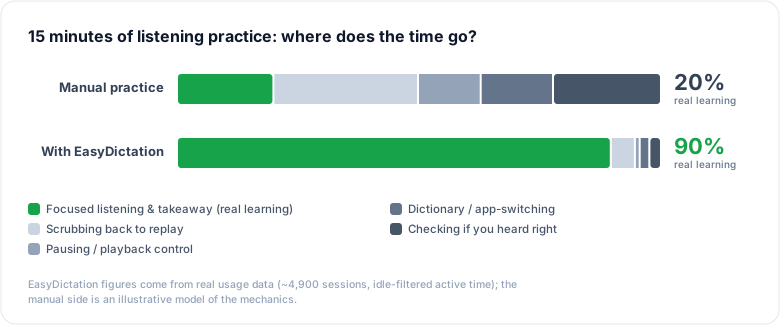
You put in a serious 15 minutes of listening practice a day. But if you measured where those 15 minutes actually go, you'd be surprised. Most of them aren't spent learning — they're spent on mechanics: rewinding the clip you just heard, hitting pause, opening a dictionary, hunting for whether you got it right. The part where your brain does real work — listening hard and locking in the takeaway — is left with a small sliver.
This is why so many people try dictation for a few sessions and quit. Not because the method is bad — but because doing it by hand is slow and exhausting, and they can feel (without naming it) that their effort isn't buying much progress.
Three levels of listening practice — and why most people are stuck at level 1
Listening practice isn't one thing. It's three levels, each deeper than the last:
Level 1 — Watching with subtitles. You get the gist, you enjoy it, you're exposed to a lot of English. But there's a trap: your eyes read for your ears. You feel like you understood — you were actually reading. So you skim, you never fix what your ears miss, and the same gaps repeat forever.
Level 2 — Dictation. You're forced to write down exactly what you hear. Anything your ears skipped shows up as a blank you can't fake. This is the level that fixes level 1's blind spot — and, crucially, it trains you on how native speakers contract, rush, swallow and drop sounds, all the things subtitles hide.
Level 3 — Shadowing. Everything level 2 does, plus repeating aloud to train speaking. This is the deepest level — in through the ears and out through the mouth, forcing you to reproduce the exact rhythm and linking you just heard.
No level is "wrong." But if you've been watching English for ages and still can't keep up with real speech, you're almost certainly stuck at level 1. The way out is to climb to levels 2 and 3.
The problem: climbing to level 2–3 by hand is brutal
Look back at the chart. For every single sentence, doing it manually means you:
- Scrub the video back to the right spot — usually overshooting, then fishing around.
- Pause at the right moment, play, pause again.
- Check whether you heard right yourself — the video has no per-sentence answer key.
- Jump to a dictionary for each unfamiliar word, then find your place again.
Add it up and most of your time is fighting the tool, not learning. In our illustrative model, only about 20% of a 15-minute session actually goes to focused listening and takeaway. The other 80% evaporates into mechanics.
Where learners actually trip up
Dictation works because it exposes exactly what your ears skip. We know this because EasyDictation automatically logs every word a user types wrong or gives up on — 22,873 words so far, across roughly 3,900 learners. When we ranked them, the result surprised us: the hardest words to hear aren't hard words, they're the smallest ones.
| Most-misheard word | Learners | Avg. tries to get it |
|---|---|---|
| the | 147 | 3.3 |
| and | 118 | 2.6 |
| to | 110 | 2.9 |
| of | 94 | 2.6 |
| is | 88 | 1.9 |
| you | 87 | 2.3 |
Native speakers don't pronounce function words (the, and, to, of) the way they're written — in natural speech they become weak forms and get swallowed into the words around them. With subtitles, your eyes glide over them while your ears never actually caught them. Dictation is where you're forced to hear them — and that's where the skill actually grows.
So what does "effective" mean?
Not more hours. It means raising the share of each session spent on real learning. A smart tool doesn't make you study more — it deletes the mechanics so your effort lands where it counts: hearing, noticing, and locking it in.
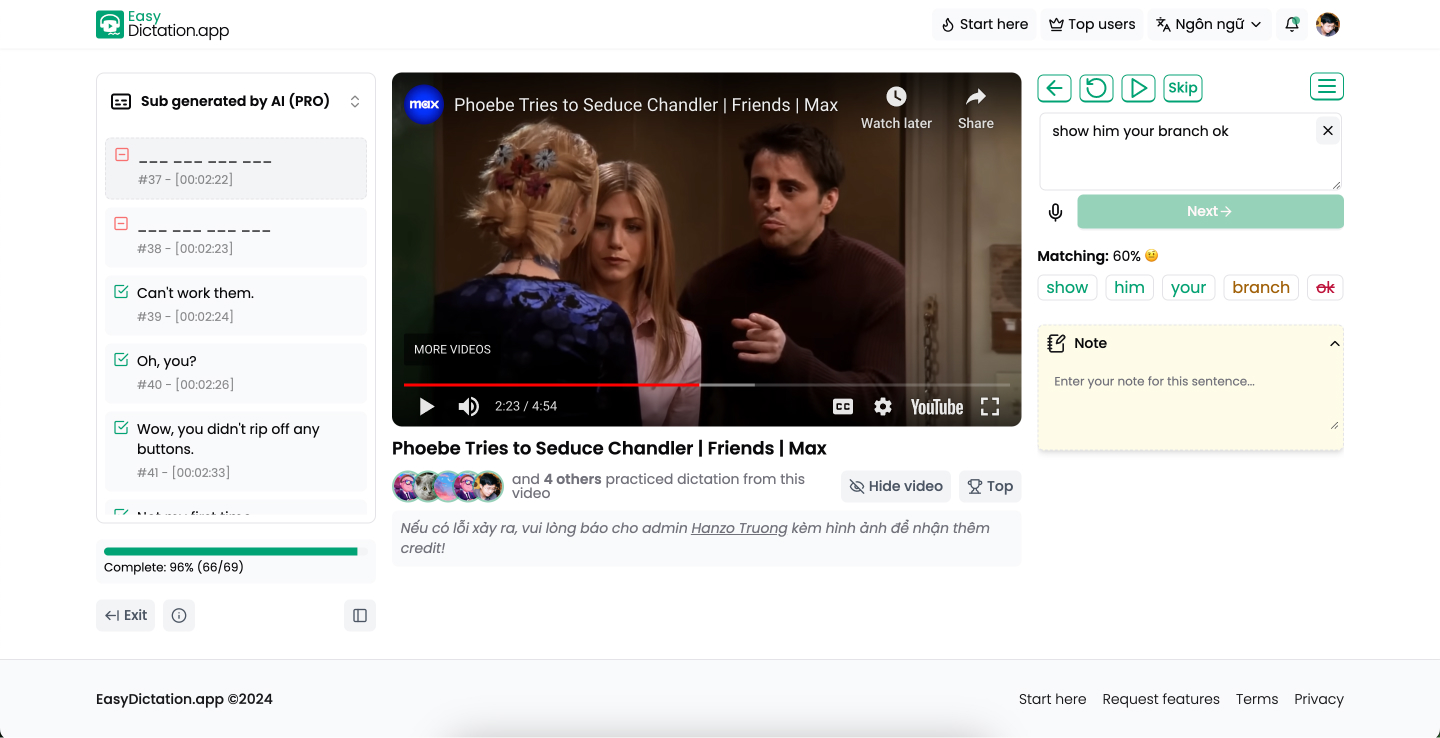
That's exactly what EasyDictation focuses on. It auto-splits sentences, gives you one-key replay, reveals the answer instantly so you see your mistake right away, and lets you save new words in place without leaving the page. The result: nearly all of your 15 minutes goes into the lesson, not into scrubbing and checking. On real data, our users average about 8.5 focused minutes and 17 sentences per session — most of it real learning.
A confession: we didn't plan to write this article. Watching learners pour their effort into mechanics instead of into the lesson — session after session — is the reason EasyDictation is built the way it is.
How to run an effective 10–15 minute session
- Pick a video slightly below your comfort zone — you should catch most of it on the first listen.
- Work one sentence at a time. Type exactly what you hear. Don't peek.
- Replay as many times as you need before revealing the answer — catching weak forms takes repetition.
- Chase the sound, not the meaning. Ask "what sounds did I just hear?", not "what does this mean?". Meaning comes after.
- Do 10–15 focused minutes. Come back tomorrow.
FAQ
Is dictation good for beginners? Yes, if you pick easy material. Beginners benefit most from short, clear clips (news-for-learners, slow vlogs). The method is the same; only the difficulty changes.
How long until I notice a difference? Most people feel their ear sharpen within two to three weeks of daily 10-minute sessions — usually first with the small connecting words that used to disappear.
Should I do dictation or shadowing? Do both, for different goals: dictation to understand fast speech, shadowing to produce it. If you can only pick one and your problem is comprehension, start with dictation.
Usage figures come from anonymized, aggregate EasyDictation data as of July 2026 (~3,900 learners, ~85,000 sentences practiced, 22,873 auto-logged misheard words). Time-breakdown chart: the EasyDictation side is based on real data; the manual side is an illustrative model of the mechanics.
Want to try it on a video you actually like? Paste any YouTube link and EasyDictation turns it into a dictation lesson — so your 15 minutes go to real learning.
Learn English with videos you love
Paste any YouTube link and start dictation practice in seconds. Free to start.
Start free