
When to use 's and when to use of, settled by one question
The team behind EasyDictation, a dictation tool that turns YouTube videos into listening practice, with our own transcription, phrase splitting and translation.
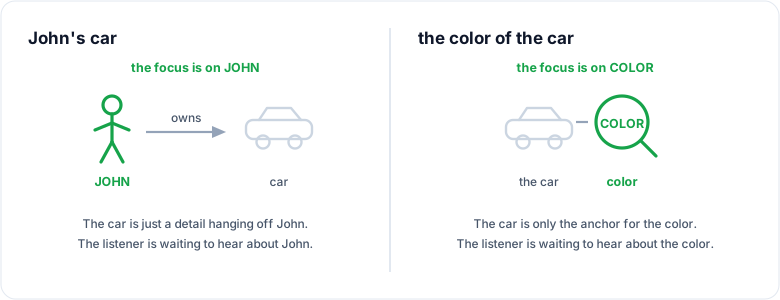
Both of these are grammatical:
John's car the car of John
Yet nobody says the second one. A native speaker will understand it, then quietly frown.
Grammar books usually handle this with a long table: use 's for people, use of for things, followed by twenty lines of exceptions. You memorise the table, and the next time you actually have to write something you freeze exactly as before.
Throw the table away. One question does the whole job:
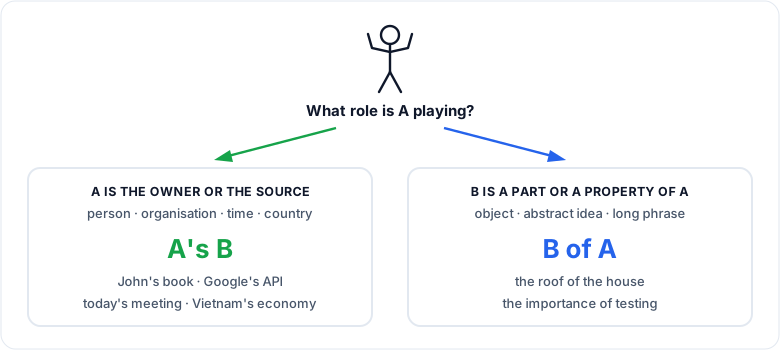
In what way does B belong to A?
Two shapes, two different centres of gravity
English has two ways to join A and B, and they differ in who the listener is waiting to hear about.
A's B puts A first, so A is what the phrase is about:
John's car, we are talking about John, the car is a detail. Google's CEO, we are talking about Google. the company's strategy, we are talking about the company.
B of A puts B first, so B is what the phrase is about:
the color of the car, we are talking about the color, not the car. the size of the dataset, we are talking about the size.
Same car, two phrases, two different centres of gravity. Pick the wrong one and you are still understood, you are just stressing the wrong half.
Why "the car of John" feels off
Because John and the car are linked too directly. John owns it, end of story, there is nothing further to unpack. When the relationship is that obvious and you still route it through of, the phrase sounds like it is reaching for a formality nobody asked for.
Going the other way, 's does not really require ownership either. All of these are natural even though nobody owns anything:
my experience · today's meeting · the model's performance · the camera's lens
The name "possessive" is what misleads people here. 's is not asking who owns the thing. It is asking where the thing came from.
Four groups that almost always take 's
| Group | Examples |
|---|---|
| People | John's book · Mary's idea · the customer's order |
| Organisations | Google's model · OpenAI's API · Microsoft's strategy |
| Time | today's meeting · yesterday's news · tomorrow's deadline |
| Countries | Vietnam's economy · Japan's population |
What they share: A is something that can actively produce B. Google produces Google's model. Today produces today's meeting.
Three groups that usually take of
| Group | Examples | Why |
|---|---|---|
| Abstract nouns | the importance of testing | testing's importance is grammatical and almost never written |
| Measurements | the size of the dataset · the accuracy of the model | the subject is the number, not the dataset |
| Parts | the roof of the house · the end of the road · the top of the mountain | a roof is part of a house, the house does not create it |
All three share the same thing: A is not an owner, A is just the anchor you use to locate B.
The longer the phrase, the more of wins
This one is mechanical, and it explains a batch of cases that the "person or thing" rule cannot touch.
's has to attach to the last word of A. When A is short, no problem. When A grows, the listener has to carry the entire phrase before finding out what you are even talking about.
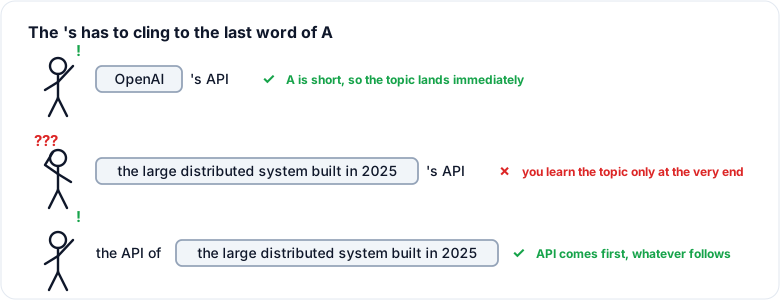
OpenAI's API ✅ short, lands instantly. the large distributed system built in 2025's API ❌ exhausting. the API of the large distributed system built in 2025 ✅ you know it is about the API from word three.
In short: of lets you lead with the thing that matters and postpone the long qualifier. 's cannot do that.
What happens in technical writing
Learners often drift here, because "things take of" pushes them to write of everywhere. Native technical writers reach for 's constantly:
the model's output · the agent's memory · the system's architecture · the user's request
Those read better than the output of the model. The reason is the same question as before: in that context the model is being treated as an agent that produces the output, not as an inert object.
Move to abstract nouns and of takes over again:
the importance of evaluation ✅ evaluation's importance ❌ grammatical, and odd out loud
When both are fine
Plenty of pairs work either way, differing only in register:
A's B | B of A |
|---|---|
| the model's performance | the performance of the model |
| my company's culture | the culture of my company |
| the city's population | the population of the city |
The left column is tighter and more conversational, common in blogs and speech. The right column is more formal and leans harder on B, common in academic writing. With pairs like these you cannot really get it wrong.
Two questions and you are done
Before you write, ask quickly:
Is A the owner or the source of B? Then
A's B. the user's question · the model's output · my team's project
Or is B merely a part, a property, a measurement of A? Then
B of A. the size of the dataset · the quality of the response · the importance of testing
Still torn? Say both out loud. Take whichever is shorter and reveals the topic sooner.
Knowing the rule is one thing, reaching for the right one without thinking is another. Native speakers never studied a table. They get it right because they have heard it tens of thousands of times in real speech. That is the part you have left, and it is where EasyDictation helps: real YouTube videos, typed back phrase by phrase, so 's and of settle in through your ears instead of a grammar table.
Learn English with videos you love
Paste any YouTube link and start dictation practice in seconds. Free to start.
Start free