
The present perfect definition you were taught is missing one word
The team behind EasyDictation, a dictation tool that turns YouTube videos into listening practice, with our own transcription, phrase splitting and translation.
🇻🇳 Bạn là người Việt? Câu định nghĩa bị mổ xẻ trong bài này chính là câu quen thuộc trong sách ngữ pháp Việt Nam. Đọc bản tiếng Việt sẽ rõ hơn nhiều.
If you learned English in Vietnam, you learned the present perfect from one sentence. Every grammar book prints it, word for word:
An action that happened in the past and continues to the present.
It is the first thing you are taught about the tense, and it is the reason you go on misusing it for years afterwards. English-language textbooks often phrase it loosely too, but the Vietnamese wording — kéo dài đến hiện tại, "stretches all the way to now" — is unusually literal, so the damage it does is unusually clean.
Try the definition on a real sentence
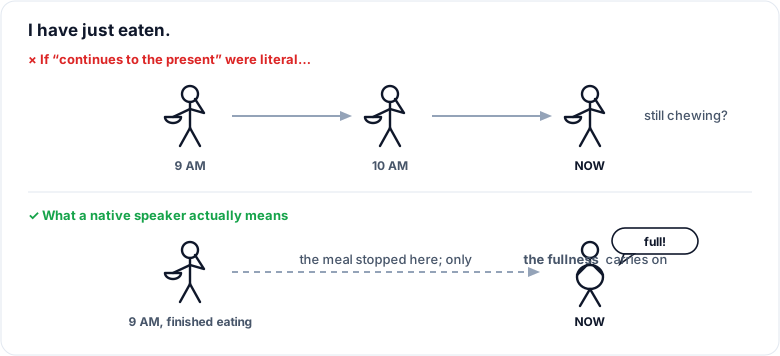
I have just eaten.
Apply the definition literally. "Eat" is an action that happened in the past and continues to the present. So you started at 9 AM and you are still chewing.
Obviously not. The meal ended long ago.
Try a few more sentences and the definition breaks the same way every time:
| Sentence | The definition forces you to read it as | What is actually true |
|---|---|---|
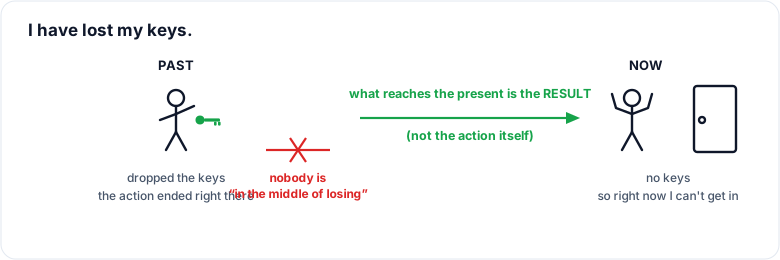
| I have lost my keys. | Losing them, over and over | They fell once, and that was that |
| I have broken my phone. | Still snapping the phone in half | One crack, done |
| I have been to Japan. | Currently in Japan | Home for years now |
Four sentences, four failures — and these are the most basic examples in the book.
What the definition leaves out
It isn't entirely wrong. It describes exactly one case correctly:
I have lived here for ten years. → true, the living really does continue.
The mistake is taking what is true in one case and applying it to all of them. The faulty word is "continues", and the question it never answers is: what continues?
The textbook lets you assume it's the action. That's the gap.
What continues to the present is the result, not the action.
Add that one word and the definition finally holds:
An action happened in the past, and its result continues to the present.
The same four sentences, second attempt
| Sentence | Action (past, finished) | Result (still true now) |
|---|---|---|
| I have just eaten. | Eating | I'm full |
| I have lost my keys. | Dropping them | I can't get into my flat |
| I have broken my phone. | Breaking it | The phone is broken right now |
| I have been to Japan. | The trip | I have that experience |
| I have lived here for ten years. | Moving in | I'm still here |
Nothing breaks this time. Not even the last one — the sentence the old definition described correctly still works under the new one.
This is also why "I have lost my keys" stops being usable the moment you find them. The losing is still sitting there in the past; nothing can undo it. But the result is gone, so the sentence dies with it, and you have to fall back on plain storytelling: "I lost my keys yesterday, but I found them."
Why "continues" is such an expensive word
Because English already has a tense whose whole job is the action continuing:
I have been waiting for an hour. (present perfect continuous)
The textbook definition describes the continuous and then attaches it to the simple present perfect. So when you finally reach have been V-ing, the two look identical and you have no basis for choosing. They are not remotely identical:
I have painted the kitchen. → look, the kitchen is new. This is about the result. I have been painting the kitchen. → that's why I'm covered in paint, and I may not be done. This is about the process.
One line is enough to keep them apart: the perfect reports a result, the continuous reports a process.
The takeaway
Throw the old sentence out and keep this one:
It happened in the past, but the point you're making is about now.
Before you write have + V3, ask one question: what did that event leave behind in the present? If you can answer it, the tense is right. If there's nothing left behind and you're simply telling a story, use the past simple.
And just, already, yet, ever, never? Those are words that often turn up nearby, nothing more. Americans say "I just ate" all day long and the sky doesn't fall.
Understanding this and using it by reflex are two different distances, though. Native speakers never learned any of these tables; they pick the right tense because they've heard the pattern tens of thousands of times in real speech. That's the stretch you have left, and it's the part EasyDictation is built for: take a real YouTube video, type out what you hear phrase by phrase, and let the grammar arrive through your ears instead of through a table.
Learn English with videos you love
Paste any YouTube link and start dictation practice in seconds. Free to start.
Start free