
As or when? Swap one word and the whole sentence changes meaning
The team behind EasyDictation, a dictation tool that turns YouTube videos into listening practice, with our own transcription, phrase splitting and translation.
You are writing a sentence:
The more the company expands, the more engineers we hire.
You reach the join between the two halves and your hands stop. as? when?
The dictionary makes it worse, because both words come back with the same gloss. So you pick one, ship it, and never find out whether it sounded right.
The trouble is that these two are not interchangeable. Swap as for when and the sentence says something else:
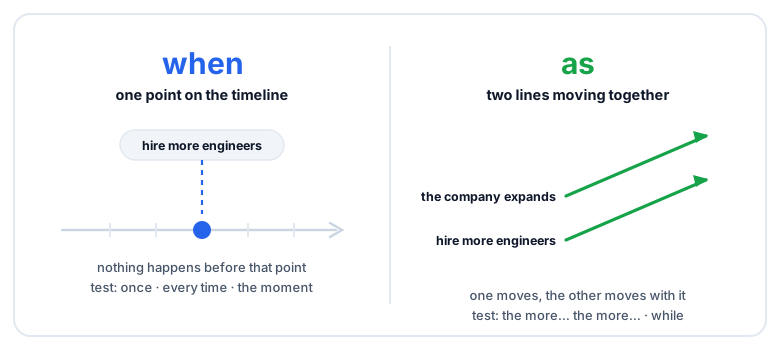
We hire more engineers as the company expands. Growth and hiring move together, right now, step for step.
We hire more engineers when the company expands. Growth is a trigger. Until it happens, nobody gets hired.
The first sentence is a process in progress, two things inching forward side by side. The second is a threshold: before it, nothing. A native reader hears that difference immediately.
Two words, two pictures
when is a single point on the timeline. Reach it, and the other thing happens.
as is two parallel lines. However far one of them travels, the other travels with it.
Hold on to those two pictures and most situations sort themselves out.
Test one: does "the more… the more…" fit?
English has a ready-made frame for lines that move together: the more… the more…. Any sentence you can say that way takes as.
The closer you get, the sharper the picture. The picture gets sharper as you move closer.
The nearer the deadline came, the quieter the office got. As the deadline approached, the office got quieter.
The older she got, the less she spoke. As she got older, she spoke less.
There is a second, blunter version of the same test: swap in "while". If while fits without damage, the two clauses genuinely overlap in time, and as is safe. While she got older, she spoke less is clumsy but recognisably the same idea; while you press this button is not.
Put when into those three sentences and the grammar survives but the meaning slides. When she got older, she spoke less sounds like she hit some particular age and fell silent, not that she talked less and less over the years.
Test two: does "once…" or "every time…" fit?
Run it the other way. If the sentence works with once… or every time… or the moment…, you want when.
Press this button and the light comes on. When you press this button, the light turns on.
Every time it rains, the yard floods. When it rains, the yard floods.
Nothing here is inching forward. There is a trigger, and past the trigger the other thing fires. Forcing as in sounds strange, because pressing a button has no duration to run alongside — there is nothing for a parallel line to be parallel to.
That is the aspect test in plain terms: as wants two things in progress, so its clauses lean on continuous, gradual verbs (expands, approached, got older). when is happy with instant, punctual ones (press, arrives, rains).
Interruptions are where when really lives
There is one more pattern, and it is the one learners most often get backwards: an activity in progress that gets cut off.
I was walking home when it started to rain.
Notice the arrangement. The thing in progress sits in the main clause, and when attaches to the event that interrupts it — the rain. Plenty of people write it the other way round: When I was walking home, it started to rain. That is not wrong, but the jolt is gone. The interruption reading depends on when pointing at the sudden thing, not at the background.
as can take that slot too, and it is much gentler:
As I was walking home, it started to rain.
Now the two events simply overlap. Nobody is startled.
Careful: as has two other jobs
This is where learners get tangled, because as is a word that moonlights.
As it was raining, we stayed in. → here
asmeans because. She works as a translator. → hereasmeans in the role of.
Neither has anything to do with time. Position gives them away. Time as has two clauses both describing something in progress. Causal as is followed by a reason, and you can usually swap in since or because. Role as sits directly in front of a noun rather than heading a whole clause.
The cheat sheet
| If the sentence works as | Choose | Example |
|---|---|---|
| the more… the more… · while… | as | the closer you get, the sharper it looks → as you move closer |
| once… · every time… · the moment… | when | every time it rains the yard floods → when it rains |
| something in progress, then a jolt | when, attached to the jolt | I was walking home → …when it started to rain |
Compressed: as means two things moving together, when means reach the point and it happens.
Back to the sentence
Look at the opening line again. "The more the company expands, the more engineers we hire" already sits in the the more… the more… frame, so the answer is:
We hire more engineers as the company expands. ✅
These two words are hard not because the rule is complicated, but because a bilingual dictionary flattens them into one entry. Drop that entry. Read the sentence once through the more… the more… and once through once…, and go with whichever version does not fight you. Prepositions and conjunctions behave the same way in other pairs, too — the geometry of through, throughout and across and the focus rules behind 's versus of yield to exactly this kind of picture-first thinking.
Knowing the rule and reaching for it without thinking are still two different distances, though. Native speakers are not drawing diagrams in their heads. They have heard as the company grows so many times that when the company grows trips an alarm on contact. That is the stretch you have left, and it is where EasyDictation helps: take a real video, type it back phrase by phrase, and let these little joining words get familiar to your ear first.
Learn English with videos you love
Paste any YouTube link and start dictation practice in seconds. Free to start.
Start free